
India, the US and 12 other members of the IPEF grouping have signed a supply chain resilience agreement that would help mitigate risks of economic disruptions from supply chain shocks and improve crisis coordination. The agreement would help member countries like India to reduce their dependence on China and provide timely information to the IPEF member countries about potential supply disruptions. The COVID outbreak severely disrupted the global supply chain, as most countries were dependent on China for various products like pharma raw materials.

The G20 declaration, which hit snags on the language to describe the Ukraine war, amounted to a 'coup' for host Prime Minister Narendra Modi though the final compromise statement reflected a stand far softer than those the United States and its Western allies have adopted on Russia, the world media said on Sunday.

Iran and Saudi Arabia have agreed to re-establish diplomatic relations and reopen embassies after talks in Beijing between officials from the two rival Middle East powers, Iranian state media reported on Friday.

Makki and other LeT/JUD operatives "have been involved in raising funds, recruiting and radicalising youth to violence and planning attacks in India, particularly in Jammu and Kashmir (J&K)," the sanctions committee said, providing a statement for the reasons of Makki's listing.

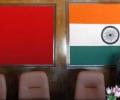
India on Friday strongly protested China's decision to issue invalid visas to some of its athletes for the Asian Games.
The Center for Preventive Action, established in 1994 by the United States council on foreign relations to prevent, defuse, or resolve deadly conflicts around the world to expand the body of knowledge on conflict prevention, has published a survey, identifying possible contingencies which have a likelihood to occur in 2013.

Regional States will be worried that the US's nascent engagement with the Taliban behind the fig leaf of humanitarian aid enables the return of US intelligence personnel to Afghanistan, observes Ambassador M K Bhadrakumar.

The agency had received Rs 946.51 crore to manage its affairs in the Budget Estimates for 2023-24, which was later increased to Rs 968.86 crore in the Revised Estimates.
Indicating a tacit understanding between Islamabad and Washington over drone strikes, a United States scholar has said the Pakistan government has now publicly asked the US administration to stop drone strikes, but has not taken any measure against it. In fact, the Pakistani government continues to clear the air space whenever the United States asks them to do so for their drone strikes.
India's economy is slowing down due to domestic issues, says Sumit Ganguly.

Pakistan Foreign Minister Shah Mahmood Qureshi on Wednesday said that the perpetrators of the terror attack on Mumbai are not friends of Islamabad and such terror organisations need to be checked, curtailed and shut. "Those who carried out the Mumbai terrorist attack that killed 166 innocent people are not friends of Pakistan," Qureshi, who is on a visit to United States, said at the Council of Foreign Relations, a Washington-based think tank.
In the wake of the United States covert operation by an elite squad of the Navy SEALs that killed Al Qaeda lynchpin Osama bin Laden, Richard N Haass, president of the influential Council on Foreign Relations, said it's d
Union Minister for Commerce and Industry Anand Sharma has shrugged off the recent irritants that have cropped up less than six weeks before US President Barack Obama makes his visit to India as 'transient negativity', and predicted they would 'get dissipated' soon.
The US Secretary of State Hillary Clinton should be prepared to make 'compromises on global issues' on which the United States and India have disagreed in the past, during her maiden visit to India this week, a foreign policy expert said on Thursday.
During her visit to India this week, United States' Secretary of State Hillary Clinton should be prepared to make 'compromises on global issues', on which the US and India have disagreed in the past, a foreign policy expert said. Evan A Feigenbaum, senior fellow for East, Central and South Asia, said these include the international trade regime and possibly some arms control treaties. "The challenge will be to manage these disagreements toward compromise," he said.

Although the credit for acquiring the technological skill must be given to India's outstanding nuclear scientists, the decision to go nuclear was a political one that entailed clarity of vision, courage and resolve, points out Rup Narayan Das.

'The future of BRICS is under stress as Chinese attempts to expand the platform are being resisted by India and Brazil.' 'Beijing is focused on a quick expansion with the aim of giving the platform a distinctly anti-Western orientation, which New Delhi and Brasilia seem to have no interest in,' notes Harsh V Pant.
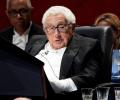
Speaking about the issue in India in March 2012 at a media conclave, Kissinger defended his use of unparliamentary language while referring to Prime Minister Indira Gandhi.
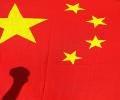
China on Saturday maintained silence on India's abstention at the voting at the UNHRC on the human rights situation in Xinjiang
"The most dangerous place in the world right now, I think, is India-Pakistan," George Schultz, who served as the Secretary of State from 1982 to 1989 in the Regan administration, said on Tuesday during his appearance before the Council on Foreign Relations, a Washington-based think tank.
Richard N Haass, president of the Council on Foreign Relations and an erstwhile senior administration official, has predicted that domestic politics and factionalism will hold back India from becoming a major player in the global arena. Haass, who was in India recently and was witness to the political bickering over the India-United States civilian nuclear deal, also argued that the challenge to India would be "the tension between the central level and the periphery."

'At the heart of the strategic relationship between our countries are economic ties.'

PCB chief Najam Sethi said that they had sent a proposal to ACC that India can play their matches at a neutral venue.

A Chicago-based man, Joseph M Czuba, aged 71, has been arrested and charged with murder and hate crimes after allegedly stabbing and killing a 6-year-old boy and seriously wounding his mother.
The fundamental challenge to United States-India strategic cooperation is China, says Daniel Markey, senior fellow for India, Pakistan, and South Asia at the Council on Foreign Relations, where he specialises in security and governance issues in the subcontinent.
Ahead of United States President Barack Obama administration's Afghanistan-Pakistan strategic review in December, an independent task force report on Pakistan and Afghanistan, sponsored by the respected and influential Council on Foreign Relations, has said a long-term partnership with Pakistan 'can be sustained only if Pakistan takes action against all terrorist organisations based on its soil.'
United States Senator Carl Levin, the influential and much respected chairman of the powerful Senate Armed Services Committee, has blasted the Pakistani government for its hypocrisy in privately condoning the US predator drone attacks to eliminate the terrorists in meetings with American officials, and then publicly condemning them as a violation of that country's sovereignty.He argued that these public protestations were a bigger problem.

India on Friday launched a no-holds-barred attack on Pakistan Foreign Minister Bilawal Bhutto-Zardari for his 'uncivilised' outburst against Prime Minister Narendra Modi and said the comments were a 'new low' even for that country.

EAM Jaishankar's mission is aimed at strengthening India's strategic autonomy in a complex international environment, observes Ambassador M K Bhadrakumar.
US Under Secretary of State for Political Affairs Nicholas Burns -- the chief interlocutor of the US-India civilian nuclear deal -- who will resign in March, has said he is elated that India has asked its Ambassador to Washington Ronen Sen to stay on for another year, describing it as "good karma".
The United States is in danger of losing its lead in technology and innovation sector to Asian nations such as India, China, South Korea, Malaysia, Taiwan and Singapore, a senior foreign policy expert has said.
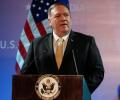
The United States, he said, 'desires a new age of ambition' in its relationship with India. Asserting that the US has never been more supportive of India's security, he said New Delhi too, is an important partner and a key pillar of President Trump's foreign policy.

Weeks before Canada made an explosive allegation implicating Indian officials in the killing of Sikh separatist leader Hardeep Singh Nijjar, Canadian officials sought public condemnation of the murder from their allies, including the United States, but were met with reluctance, The Washington Post reported.
Replying to a question on the Kashmir issue raised by a Pakistani journalist, Chinese foreign ministry spokesperson Mao Ning during a media briefing in Beijing said that China's position on the issue of Kashmir has been "consistent and clear".

Sri Lanka's new president will embark on a 4-day visit to February 15.

"China has been promoting peace and stability in this region. We hope that Pakistan and India will maintain friendly relations," he told a media briefing in Beijing.
As the debate on outsourcing dominates the presidential election campaign in the United States, a leading economist has termed Democratic nominee John Kerry's opposition to American companies moving jobs overseas as faulty economics.

'To the believers of crypto regulations, I have only one question to ask, how will you regulate it?'
Hours after the United States Secretary of State Hillary Clinton landed on a historic trip to Myanmar, the country's pro-democratic leader, Aung San Suu Kyi said that India needs to do more in her country to establish true democracy.
